
House
Speaker Mike Johnson, R-La., is preparing for a vote Tuesday on a bill, which,
if passed, will prevent a partial government shutdown during the first 100 days
of President Donald Trump's presidency.
With no
Democrats willing to rally behind him, Johnson is taking his chances relying on
Republicans alone on the 99-page measure to continue financing federal agencies
until Sept. 30.
Congress has
to move to prevent a partial government shutdown by Friday, March 14. Despite
dozens of conservatives who defected on continuing resolutions in the last two
years, Trump on Saturday urged Republicans to come together and back the bill.
"The
House and Senate have assembled, under the circumstances, a great funding Bill
('CR')! Vote (Please!) all Republicans YES next week," Trump posted on
TRUTHSocial. "Great things are ahead for America, and I am requesting that
you all allow us a few months to take us to September so that we can keep on
making the Country's 'financial house' right. Democrats will do whatever they
can to close down our Government, and we can't let them."
CONGRESS UNVEILS SPENDING PLAN AFTER TRUMP CALLS ON
REPUBLICANS TO AVOID GOVERNMENT SHUTDOWN

Speaker of the House Mike Johnson, R-La., walks through the Capitol, Monday, March 3, 2025, in Washington. (AP Photo/Julia Demaree Nikhinson)
"We
must remain UNITED — NO DISSENT — Battle for a day when it is the proper
time," Trump continued. "VERY IMPORTANT. MAKE AMERICA GREAT
AGAIN!"
However,
certain Republicans have already indicated they would not vote in favor of the
CR.
"I will
not be voting for the Continuing Resolution budget (cut-copy-paste omnibus)
this week," Rep. Thomas Massie, R-Ky., wrote on X on Sunday. "Why
would I vote to continue the waste fraud and abuse DOGE has uncovered? We were
assured the CR in December would take us to March when we would battle. Here we
are in March, punting again! WTFO."
Rep. Ralph
Norman, R-S.C., on the other hand, has never voted for a continuing resolution,
but he supports Johnson's initiative. He believes he has faith in Trump and the
Department of Government Efficiency, headed by Elon Musk, to be able to make a
difference in the country's debt. "I don't like CRs," Norman said.
"But what's the alternative? Negotiate with Democrats? No."
During a
press call on Saturday, aides to House Republican leaders explained that the
bill makes provision for $892.5 billion in discretionary federal defense
appropriations, and $708 billion in non-defense discretionary appropriations.
The aides
underscored that the bill was "closely coordinated" with the White
House – though short of declaring Trump fully supported the measure, given that
he hasn't had time to review the actual pages yet.
It adds another $8 billion in defense dollars in what appears to be an effort to calm national security hawks' worries, while Congressionally appropriated non-defense spending would fall by some $13 billion.

President Donald Trump waves before departing on Marine One from the South Lawn of the White House, Friday, March 7, 2025, in Washington. (AP Photo/Alex Brandon)
There is
also a $6 billion added for veterans' healthcare.
The White
House asked for extra spending in categories not included in the previous
government spending extension, which is "anomalies." Among the
anomalies Trump has asked for and which the bill is satisfying is extra money
for Immigration and Customs Enforcement (ICE). Aides explained the money is to
cover "an operations shortfall that goes back to the Biden
administration."
"That
money, the majority of that, has been committed before this administration even
began. So that request is indicating a pre-existing gap," said a source.
The bill
also guarantees compliance with spending limits imposed under an earlier
bipartisan accord, the Fiscal Responsibility Act (FRA). The FRA required not
more than a 1% increase in federal spending in FY 2025.
The non-defense discretionary cuts would be achieved by removing certain "side deals" negotiated under FRA, House GOP leadership aides explained. Members of Congress would also not be allowed to ask for appropriations for special district pet projects referred to as earmarks, another category the Republicans are labeling as savings.
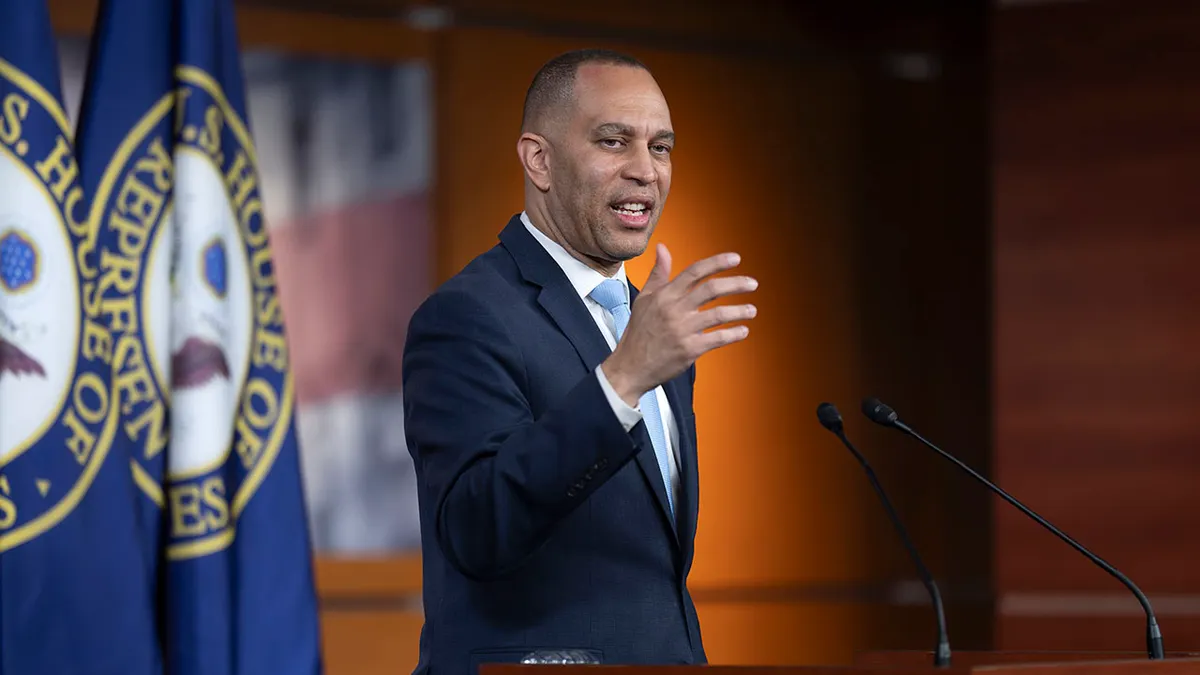
House Minority Leader Hakeem Jeffries, D-N.Y., speaks during a news conference at the Capitol, in Washington, Thursday, March 6, 2025. (AP Photo/J. Scott Applewhite)
The bill
doesn't fund most of the government expenses, such as Social Security and
Medicare. Finance for the two programs is set on autopilot and isn't
periodically examined by Congress. Democratic leadership still condemned a
statement this Saturday stating that they were outraged the bill won't make
measures to defend these programs and Medicaid, which the Republicans are
considering using to defray the costs of continuing the tax cuts legislated in
Trump's first two years.
"We are
voting no," said a group of House Democratic leaders, including House
Minority Leader Rep. Hakeem Jeffries, D-N.Y.
The leaders
of the House and Senate Appropriations Committees, Connecticut Rep. Rosa
DeLauro and Washington Sen. Patty Murray, both released statements criticizing
the bill.
Murray
stated the bill would "give Donald Trump and Elon Musk more authority over
federal spending — and more authority to choose winners and losers, which
endangers families in blue and red states alike." DeLauro, in an X post,
referred to the CR as "a power grab for the White House."
Sen. Susan
Collins, R-Maine, chairman of the Senate Appropriations Committee, stated the
emphasis has to be placed on avoiding a shutdown since shutdowns have
detrimental effects throughout the government.
"They
need some of these crucial government workers, including our military and Coast
Guard members, Border Patrol agents, TSA screeners, and air traffic
controllers, to come in for work with no guarantee when they will see their
next paycheck," Collins said. "We can't let that happen."
Fox News
Digital's Elizabeth Elkind and the Associated Press contributed to this report